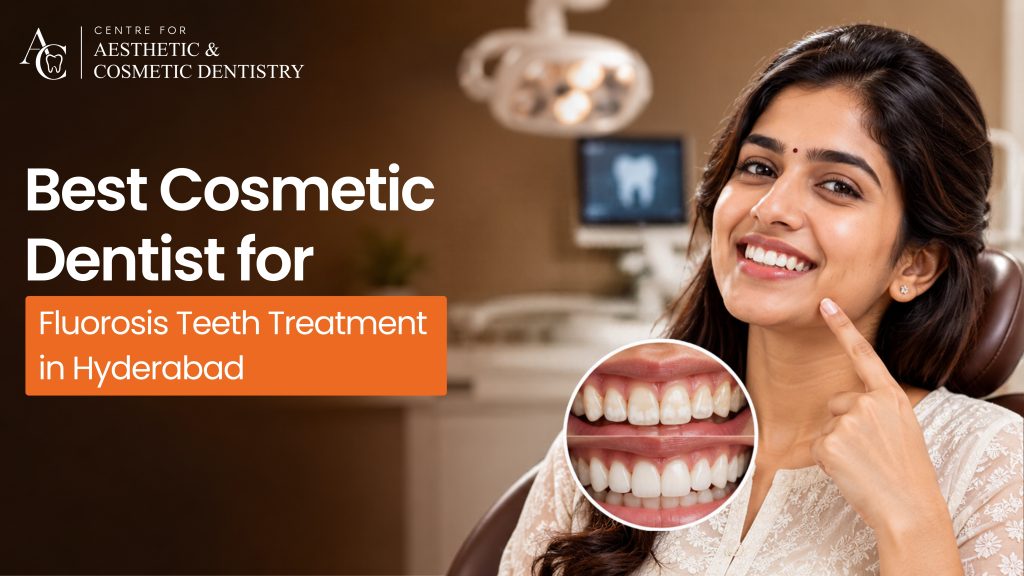
Dental fluorosis can affect the appearance of your smile, causing white patches, yellowish discoloration, or brown stains on the teeth. While fluorosis usually develops during childhood, its visible effects can remain throughout adulthood. For people who feel self-conscious about these changes, modern cosmetic dentistry offers several ways to improve the appearance of affected teeth.
If you are searching for the best cosmetic dentist for fluorosis teeth treatment in Hyderabad, understanding the available treatments is an important first step. The right approach depends on the severity of fluorosis, the condition of your enamel, your smile goals, and a professional dental assessment.
This guide explains what dental fluorosis is, how it can be treated, which cosmetic procedures may be suitable, and what to consider when choosing a dentist in Hyderabad.
What Is Dental Fluorosis?
Dental fluorosis is a change in the appearance of tooth enamel that occurs when a child receives excessive fluoride while permanent teeth are developing. This exposure generally happens during the early years of life, before the teeth fully emerge.
Fluoride helps strengthen enamel and protect against tooth decay. However, excessive intake during tooth development can interfere with normal enamel formation, resulting in visible changes.
Fluorosis is not contagious and, in most cases, does not cause pain. Its primary concern is cosmetic, although more severe cases may involve enamel irregularities.
Common Signs of Dental Fluorosis
The appearance of fluorosis varies depending on its severity. Common signs include:
- Small, chalky-white spots or lines on the enamel.
- White patches spread across multiple teeth.
- Yellow or brown discoloration.
- Visible staining that makes the teeth appear uneven in colour.
- Pitting or roughness of the enamel in more advanced cases.
Not every white spot is caused by fluorosis. Other conditions, including early enamel demineralisation and developmental enamel defects, can produce similar changes. A dentist should examine the teeth before recommending treatment.
Why Consider Fluorosis Teeth Treatment?
Your smile is an important part of your appearance and confidence. When fluorosis causes noticeable stains or patches, you may feel uncomfortable smiling in photographs, speaking in public, or meeting new people.
Cosmetic dental treatment can help create a more uniform tooth colour and improve the overall appearance of your smile.
Treatment may be worth considering if:
- White or brown patches are clearly visible when you smile.
- The colour of your teeth appears uneven.
- Stains do not improve with routine professional cleaning.
- You feel conscious about the appearance of your front teeth.
- You want to explore cosmetic options suited to your enamel condition.
The goal is not simply to make teeth look whiter. It is to choose a suitable treatment that improves appearance while preserving as much healthy tooth structure as possible.
Best Cosmetic Treatments for Fluorosis Teeth
There is no single treatment that works for every fluorosis case. A cosmetic dentist evaluates the depth of the discolouration, enamel thickness, tooth structure, and your expectations before suggesting a procedure.
Here are some commonly considered treatment options.
1. Professional Teeth Whitening
Professional teeth whitening may help improve the overall shade of teeth affected by mild fluorosis. It uses dentist-supervised whitening agents to lighten natural tooth colour.
However, whitening does not remove fluorosis spots. In some cases, lightening the surrounding enamel may make white patches more noticeable. Brown or deeper stains may also respond differently from general tooth discolouration.
A dentist can determine whether whitening is appropriate and explain what results are realistic.
2. Microabrasion
Enamel microabrasion is a conservative cosmetic procedure used for selected superficial enamel stains and irregularities.
During the procedure, a dentist applies a controlled combination of an abrasive material and an acidic agent to remove a very thin surface layer of enamel. This may reduce the visibility of shallow white or brown spots.
Microabrasion is generally more suitable for mild, superficial fluorosis. It may not provide sufficient improvement when stains are deep or enamel defects are extensive.
3. Resin Infiltration
Resin infiltration is a minimally invasive technique that may be recommended for certain white-spot lesions.
A special resin material penetrates the porous areas of enamel and changes how light passes through them. This can help reduce the contrast between the affected area and the surrounding tooth surface.
Its suitability depends on the type and depth of the enamel changes. It is not appropriate for every form of fluorosis, so clinical assessment is essential.
4. Composite Bonding
Composite bonding involves applying a tooth-coloured resin material to selected areas of the tooth to improve its appearance.
It may be considered when fluorosis causes noticeable stains, surface irregularities, or small defects that cannot be adequately corrected using more conservative methods.
The dentist carefully selects a shade that blends with the surrounding teeth. Bonding can often be completed without extensive tooth preparation, although the exact approach depends on the case.
Composite restorations may stain or wear over time and can require maintenance or replacement.
5. Porcelain Veneers
Porcelain veneers are thin, custom-made shells bonded to the front surfaces of teeth. They can improve the appearance of persistent discolouration, uneven colour, and certain enamel defects.
Veneers may be considered for moderate to severe cosmetic concerns when less invasive treatments are unlikely to provide the desired result.
Some tooth preparation is commonly required, and the procedure may involve irreversible removal of enamel. For this reason, veneers should be recommended only after careful evaluation of alternatives.
6. Dental Crowns for Severe Enamel Damage
In cases of severe fluorosis involving substantial enamel damage, a dental crown may sometimes be considered. A crown covers the visible portion of a tooth and can restore its shape, appearance, and function.
Crowns generally involve more tooth reduction than bonding or veneers. They are not usually the first choice for fluorosis that causes only cosmetic discolouration.
A dentist will consider the structural condition of the tooth before recommending this option.
Comparing Fluorosis Treatment Options
The following table provides a general overview of how common cosmetic procedures differ. The most appropriate treatment depends on your individual dental condition.
| Treatment | Commonly considered for | Tooth preparation |
|---|---|---|
| Professional whitening | General discolouration in selected mild cases | No significant enamel removal |
| Microabrasion | Superficial enamel stains | Minimal surface enamel removal |
| Resin infiltration | Selected white-spot lesions | Usually minimal |
| Composite bonding | Localised stains and surface defects | Often minimal, case-dependent |
| Porcelain veneers | Persistent, more extensive cosmetic concerns | Usually requires enamel preparation |
| Dental crowns | Severe structural damage | Significant tooth preparation |
How to Choose the Best Cosmetic Dentist for Fluorosis Treatment in Hyderabad
Choosing a dentist is one of the most important parts of achieving a satisfactory outcome. Fluorosis treatment requires more than selecting a cosmetic procedure. The dentist must understand the underlying enamel condition and recommend an approach that balances aesthetics with long-term dental health.
Consider these factors when comparing dental clinics in Hyderabad.
1. Experience in Cosmetic Dentistry
Look for a dentist who regularly evaluates and treats concerns involving tooth discolouration, enamel defects, smile aesthetics, and restorative procedures.
Ask about the treatment options they commonly use for fluorosis and whether they can explain the advantages and limitations of each.
2. Detailed Dental Evaluation
A reliable treatment plan should begin with an examination of your teeth and gums. The dentist may assess enamel thickness, the distribution of stains, existing restorations, and your bite.
Photographs or other diagnostic records may help with treatment planning. The aim is to identify the cause and severity of the discolouration before proceeding.
3. Conservative Treatment Planning
Preserving natural tooth structure should be an important consideration. A dentist should explain whether a minimally invasive treatment could achieve your goals before recommending procedures that require greater enamel removal.
For example, veneers may be appropriate in some cases, but they are not automatically necessary for every patient with fluorosis.
4. Clear Communication About Expected Results
Ask what improvement is realistically possible, how many appointments may be needed, and whether the result will require future maintenance.
A responsible cosmetic dentist will explain potential limitations rather than promise perfectly uniform or permanent results.
5. Hygiene, Technology, and Patient Care
Look for a clinic that follows appropriate sterilisation protocols and uses suitable diagnostic and treatment equipment. Clear explanations, transparent treatment planning, and a comfortable clinical environment also contribute to a positive experience.
Best Fluorosis Teeth Treatment in Hyderabad
Patients exploring cosmetic solutions for fluorosis can consider a consultation at the Center for Cosmetic & Aesthetic Dentistry by Dr Mohan Rayapudi to discuss their concerns and understand which treatment options may be suitable.
With a focus on cosmetic and aesthetic dental care, the clinic can assess the appearance and condition of affected teeth and help patients explore an appropriate treatment plan. The clinic’s experience is reflected in the milestone of 50000+ Happy Patients.
For added convenience, patients can explore care at 2 clinics in Hyderabad at Kondapur, Kukatpally.
A consultation is an opportunity to discuss the extent of fluorosis, understand available procedures, and ask questions about treatment duration, maintenance, and expected outcomes. The final recommendation should always be based on an individual examination.
What Happens During a Fluorosis Treatment Consultation?
If you are visiting a cosmetic dentist for the first time, knowing what to expect can make the process easier.
A typical consultation may involve the following steps:
- Understanding your concerns: The dentist discusses which teeth are affected, how long you have noticed the discolouration, and what you would like to improve.
- Examining your teeth: The dentist checks the enamel, tooth surfaces, gums, and bite to assess the type and severity of the changes.
- Discussing suitable options: Depending on the findings, the dentist explains whether whitening, microabrasion, resin infiltration, bonding, veneers, or another approach may be appropriate.
- Planning treatment: You receive information about the recommended procedure, appointments, expected results, limitations, and aftercare.
You should feel comfortable asking questions before agreeing to treatment. Understanding the process helps you make an informed decision.
How to Maintain Your Smile After Fluorosis Treatment
Cosmetic treatment can improve the appearance of affected teeth, but good oral hygiene remains important for maintaining your results.
Brush twice daily using a soft-bristled toothbrush and fluoride toothpaste in the recommended amount. Clean between your teeth regularly and attend dental check-ups as advised.
If you have undergone whitening or received composite restorations, ask your dentist about foods, drinks, and habits that may affect staining. Avoid using abrasive home remedies or unverified whitening products, as these can damage enamel or irritate your gums.
Remember that veneers, bonding, and other restorations may need maintenance over time. Regular dental visits help your dentist monitor their condition and address any concerns early.
Dental fluorosis does not have to define the appearance of your smile. With modern cosmetic dentistry, several treatment options can help reduce visible stains, improve enamel appearance, and create a more balanced smile.
The right solution begins with understanding your specific condition. Whether you need a conservative procedure for mild white spots or a more comprehensive cosmetic approach, an experienced dentist can help you explore suitable options.
If fluorosis-related stains are affecting your confidence, consider scheduling a consultation at the Center for Cosmetic & Aesthetic Dentistry by Dr Mohan Rayapudi. Discuss your concerns, understand the available treatments, and take an informed step towards a smile that makes you feel more comfortable and confident.
Frequently Asked Questions
1. Can dental fluorosis be treated permanently?
Fluorosis-related enamel changes generally do not disappear on their own. However, cosmetic procedures can reduce their visibility or cover affected areas. The longevity of the result depends on the treatment selected, oral hygiene, and individual dental conditions.
2. Which treatment is best for fluorosis stains?
The best option depends on the severity and depth of the stains. Mild cases may benefit from microabrasion or selected whitening approaches, while resin infiltration or bonding may help with certain visible spots. Veneers may be considered for more extensive cosmetic concerns.
3. Is fluorosis teeth treatment painful?
Many cosmetic procedures for fluorosis involve little or no discomfort. However, the experience varies according to the procedure and the condition of the teeth. If treatment involves tooth preparation, local anaesthesia may be used when appropriate.
4. Can teeth whitening remove fluorosis?
Whitening may improve the overall shade of teeth in selected cases, but it does not remove the underlying enamel changes. It may also make some white patches more noticeable. A dentist should assess whether whitening is suitable before treatment.
5. Are veneers necessary for treating fluorosis?
No. Veneers are only one of several possible options. For mild or moderate cases, more conservative procedures may be suitable. Veneers are generally considered when the discolouration or enamel defects cannot be addressed adequately with less invasive methods.