A small gap between the front teeth can be a distinctive feature, but some people prefer a more uniform smile. If you are looking for a minimally invasive way to improve the appearance of spaced teeth, composite veneers can be an option worth discussing with a cosmetic dentist.
Composite veneers, also known as direct composite bonding in many cases, use tooth-coloured resin that is carefully shaped and bonded to the teeth. The material can be used to visually reduce or close selected spaces while also improving tooth shape and proportions.
Unlike orthodontic treatment, composite veneers do not physically move the teeth together. Instead, they add carefully planned material to the tooth surfaces to change their appearance. This makes them particularly relevant for certain small or moderate cosmetic gaps when the teeth and gums are healthy.
Before choosing treatment, it is important to understand what causes dental gaps, whether composite veneers are suitable, how the procedure works, the potential benefits and limitations, expected results, cost considerations, and how to maintain the finished smile.
What Are Composite Veneers?
Composite veneers are tooth-coloured restorations made from composite resin. In a direct technique, the dentist applies the material to the tooth, shapes it, and hardens it using a curing light.
The material can be sculpted to modify the apparent width and contour of teeth. When planned carefully, composite bonding can make a gap appear smaller or, in selected cases, close a small space cosmetically.
Composite treatment may be considered for patients who have:
- Small gaps between front teeth
- Slightly uneven tooth shapes
- Minor chips or worn edges
- Teeth that appear disproportionately narrow
- Certain cosmetic discolorations
The treatment is highly customizable because the dentist can shape the composite directly on the tooth.
What Causes Gaps Between Teeth?
A gap between two teeth is called a diastema. While gaps can occur anywhere in the mouth, the most noticeable example is often a space between the upper front teeth.
Several factors can contribute to spaces between teeth. Natural tooth size and jaw dimensions may create spacing, while habits, missing teeth, gum problems, or the position of the tissue between the front teeth can also play a role.
Common causes include:
- Naturally small teeth relative to the jaw
- Missing teeth
- Differences in tooth and jaw size
- Certain oral habits
- Gum or bone-related problems
- A prominent frenum between the front teeth
- Teeth that have shifted over time
The cause matters because simply covering the gap may not always be the best treatment. A dentist should first determine why the space exists.
Are Composite Veneers Suitable for Closing Dental Gaps?
Composite veneers can be suitable for selected cosmetic gaps, particularly when the space is relatively small and the surrounding teeth are healthy.
However, they are not appropriate for every type of spacing problem.
If a gap is caused by missing teeth, significant tooth movement, gum disease, or an underlying bite issue, another treatment may be more appropriate. Orthodontic treatment, periodontal care, restorative dentistry, or a combination of treatments may sometimes be recommended.
A cosmetic dentist should evaluate the teeth, gums, bite, facial proportions, and cause of the gap before recommending composite treatment.
Composite Veneers vs Other Gap Closure Options
Patients have several possible approaches for improving spaces between teeth. The right option depends on the cause and severity of the gap.
| Treatment | How It Addresses the Gap | Main Advantage | Key Consideration |
| Composite Veneers/Bonding | Adds tooth-coloured resin to alter tooth shape | Usually conservative and relatively quick | Composite can chip or stain |
| Porcelain Veneers | Covers the front surface with customized ceramic | Durable, natural-looking aesthetics | Usually more costly and may require preparation |
| Clear Aligners | Gradually moves teeth | Addresses tooth position | Requires treatment time and compliance |
| Braces | Physically moves teeth | Suitable for many alignment problems | More visible and takes longer |
| Dental Restoration/Replacement | Replaces missing tooth structure or teeth | Addresses certain structural problems | Treatment depends on the underlying condition |
Composite veneers can be attractive when the goal is primarily cosmetic and the gap can be managed by changing tooth proportions rather than moving the teeth.
Benefits of Composite Veneers for Gaps
Minimally Invasive Approach
One of the major attractions of composite bonding is that it can often be completed with little or no removal of healthy enamel, depending on the case.
The exact preparation depends on the tooth shape, desired result, bite, and treatment technique.
Quick Cosmetic Improvement
Composite veneers can often provide a visible improvement in the appearance of a gap within a relatively short treatment period.
Unlike orthodontic treatment, which gradually moves teeth over months, composite treatment changes the visible contours of the teeth directly.
Natural-Looking Appearance
Composite resin is available in tooth-coloured shades. The dentist can layer and shape the material to create contours designed to blend with the surrounding teeth.
The final appearance depends heavily on shade selection, tooth proportions, surface texture, and the dentist’s artistic and technical skills.
Customizable Treatment
Composite can be shaped directly on the teeth, allowing the dentist to make detailed adjustments to the size, contour, and proportions of the treated teeth.
Potentially More Affordable
Compared with some porcelain-based cosmetic treatments, composite bonding can be a more economical approach for suitable cases.
However, the total cost depends on the number of teeth being treated, complexity, material, and dental practice.
What Is the Composite Veneer Procedure Like?
If you are considering composite veneers for gaps between teeth in Hyderabad, the process generally begins with a consultation rather than immediately applying the material.
Step 1: Smile and Dental Evaluation
The dentist examines the teeth and gums and evaluates the size and location of the gap. Your bite and the way your teeth come together are also important.
Photographs or digital scans may be taken to assist with treatment planning.
Step 2: Discussing Your Desired Smile
You can explain what you would like to change about your smile. The dentist can then determine whether composite bonding can achieve a realistic result.
It is important to discuss tooth width and proportions because completely closing a gap is not always the most aesthetically balanced solution.
Step 3: Tooth Preparation
Depending on the technique, the tooth surface may be cleaned and prepared to support proper bonding. In many suitable cases, extensive tooth reduction is unnecessary.
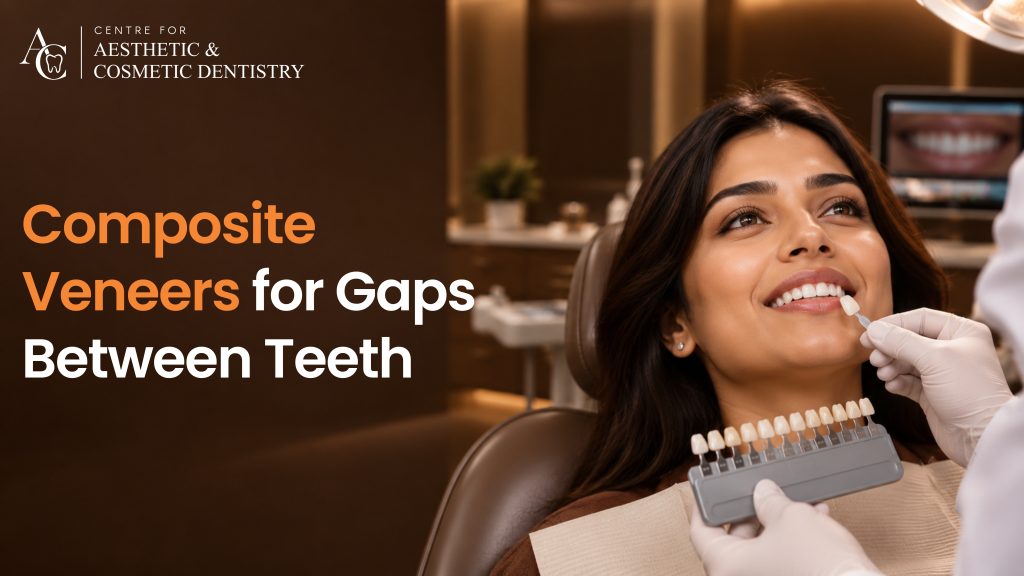
Step 4: Shade Selection
The composite shade is selected to complement the surrounding natural teeth. Multiple shades or layers may be used when necessary to create a more natural appearance.
Step 5: Composite Application
The dentist applies the composite resin and carefully shapes it to modify the tooth contours and reduce the visible gap.
Step 6: Curing and Polishing
A curing light hardens the composite. The dentist then shapes, adjusts, and polishes the restoration to achieve the desired appearance and a smooth surface.
Step 7: Bite and Aesthetic Check
The final restoration is evaluated for appearance and function. Any necessary adjustments are made so that the treated teeth fit comfortably within your bite.
What Results Can You Expect?
The result of composite veneer treatment can vary considerably depending on the size of the gap, tooth shape, material, and treatment technique.
For suitable small spaces, composite can create a visibly more uniform smile by changing the proportions of the teeth.
However, the goal should not always be to make the gap disappear at any cost. If too much material is added, the teeth may appear excessively wide or bulky.
A skilled cosmetic dentist balances the tooth width, height, symmetry, facial proportions, and smile line to create a harmonious result.
How Long Do Composite Veneers Last?
Composite veneers can provide long-lasting cosmetic improvement, but they are not considered permanent restorations.
Their lifespan can be affected by oral hygiene, biting forces, tooth grinding, diet, smoking or tobacco use, and the location of the restoration.
Composite is generally more susceptible to staining and wear than porcelain. It may also chip under excessive force.
Regular dental examinations can help identify minor chips or surface changes before they become larger problems.
Can Composite Veneers Be Repaired?
One advantage of composite restorations is that they can often be repaired or modified when appropriate.
If a small portion chips, the dentist may be able to add composite material to repair the area rather than replacing the entire restoration.
However, whether repair is possible depends on the condition of the restoration and the underlying tooth.
Composite Veneers vs Clear Aligners for Gaps
Patients frequently compare composite veneers with clear aligners because both can improve the appearance of spaced teeth, but they work in fundamentally different ways.
Clear aligners move the teeth. Composite veneers change their shape.
If the gap is primarily due to tooth positioning, orthodontic treatment may be preferable because it addresses the position of the teeth. If the teeth are healthy and appropriately positioned but appear too narrow, composite bonding may provide a more direct cosmetic solution.
In some cases, orthodontic treatment and cosmetic bonding may even be used as complementary treatments.
How Much Do Composite Veneers Cost?
The cost of composite veneers in Hyderabad varies according to the number of teeth being treated, size and complexity of the gaps, amount of composite required, dentist’s expertise, and overall treatment plan.
Treating one small gap may cost significantly less than redesigning several front teeth as part of a comprehensive smile makeover.
Patients should ask whether the quoted fee includes consultation, treatment planning, composite material, finishing and polishing, and follow-up care.
Choosing treatment solely based on price can be risky. Cosmetic dentistry requires both technical precision and an understanding of smile aesthetics.
How to Care for Composite Veneers
Maintaining good oral hygiene is essential after composite veneer treatment. Brush twice a day with fluoride toothpaste and clean between your teeth regularly.
Avoid biting very hard objects or using your front teeth to open packages. These habits can increase the risk of chipping.
It is also worth remembering that composite can stain over time. Frequent consumption of coffee, tea, tobacco, and strongly pigmented foods may affect the appearance of the restoration.
Regular professional dental check-ups and polishing when recommended can help maintain the appearance of composite restorations.
Are Composite Veneers Reversible?
One of the appealing aspects of minimally invasive composite bonding is that little or no healthy enamel may need to be removed in suitable cases.
However, “reversible” should not be interpreted as meaning there are no long-term considerations. The composite material remains bonded to the tooth, and removing or modifying it should be performed professionally.
Your dentist can explain exactly how much preparation is expected in your particular case before treatment begins.
Why Choose Experienced Cosmetic Dental Care?
Closing a gap with composite resin may appear simple, but achieving natural-looking results requires careful attention to tooth proportions, shade, anatomy, bite, and finishing.
An experienced cosmetic dentist can determine whether the gap should be closed completely or partially and whether another treatment would provide a more predictable result.
Patients considering cosmetic dentistry in Hyderabad can consult the Center for Cosmetic & Aesthetic Dentistry by Dr Mohan Rayapudi to discuss their concerns and explore appropriate options for improving gaps between teeth.
Composite veneers for gaps between teeth can be an effective cosmetic solution for carefully selected patients. They offer a relatively conservative approach to improving tooth proportions, reducing visible spaces, and creating a more harmonious smile.
However, the best treatment depends on why the gap exists. While composite bonding can alter the appearance of teeth quickly, orthodontic treatment may be more appropriate when tooth positioning or bite is the primary concern.
If you are considering composite veneers, start with a professional consultation. Discuss the cause of your dental gap, treatment alternatives, expected appearance, longevity, maintenance, and overall cost before making your decision.
The Center for Cosmetic & Aesthetic Dentistry by Dr Mohan Rayapudi can help patients explore personalized cosmetic dentistry options and determine whether composite veneers are suitable for their individual smile goals.
With thoughtful treatment planning, appropriate material selection, and proper aftercare, composite veneers can offer a conservative way to achieve a more balanced and confident smile.
FAQs
Can composite veneers completely close a gap between teeth?
They can close or significantly reduce certain small gaps, but suitability depends on the size and cause of the space. Completely closing a larger gap by adding composite may make the teeth look disproportionately wide.
Are composite veneers painful?
The procedure is generally comfortable, particularly because extensive tooth preparation may not be necessary in suitable cases. Local anesthesia can be used when clinically appropriate.
How long does composite veneer treatment take?
The treatment time depends on the number of teeth and complexity of the case. Small cosmetic corrections can often be completed relatively quickly, sometimes within a single appointment.
Are composite veneers better than braces for gaps?
Neither is universally better. Composite veneers change the appearance of teeth, while braces physically move them. If the gap is caused by tooth positioning, orthodontic treatment may be more appropriate.
Do composite veneers look natural?
They can look very natural when the shade, shape, texture, and proportions are carefully planned and the material is properly polished.