A beautiful smile can influence confidence, appearance, and the way you interact with others. If you are unhappy with chipped, stained, uneven, worn, or slightly misaligned teeth, dental veneers in Hyderabad may be one of the cosmetic dentistry options worth considering.
Veneers have become increasingly popular because they can dramatically improve the appearance of a smile while requiring relatively little treatment time compared with some other cosmetic procedures. However, veneers are not suitable for everyone, and deciding whether they are “worth it” depends on your dental condition, expectations, budget, and long-term commitment to maintaining them.
Before choosing veneers, Hyderabad patients should understand how the treatment works, its benefits and limitations, the different types available, potential costs, maintenance requirements, and alternatives. This guide explains the important factors you should consider before making a decision.
What Are Dental Veneers?
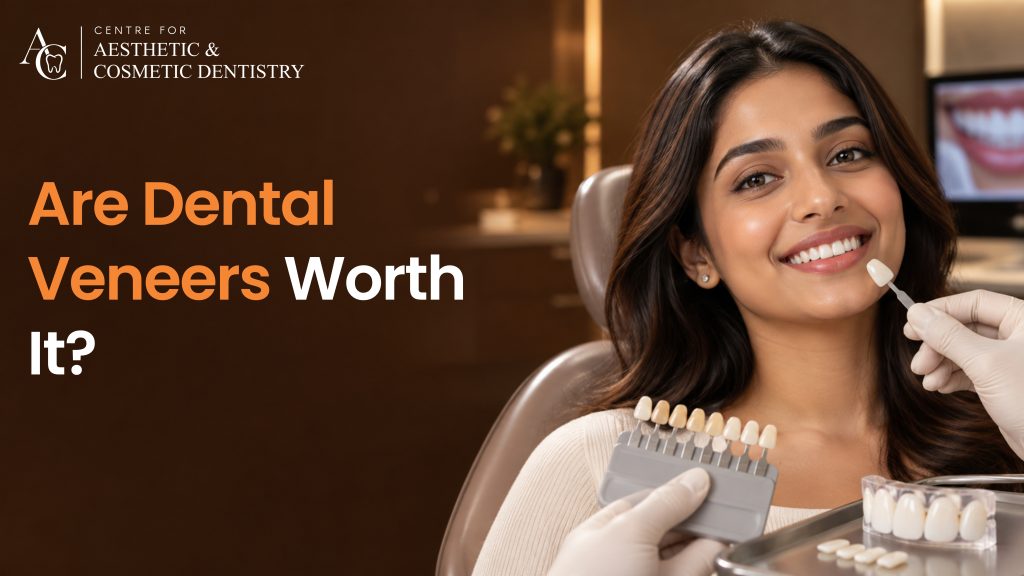
Dental veneers are thin, custom-made shells designed to cover the visible front surfaces of teeth. They are typically made from porcelain or composite resin and are bonded to the tooth to improve its shape, colour, size, or overall appearance.
Veneers can be used to address several cosmetic concerns, including:
- Persistent tooth discoloration
- Chipped or worn teeth
- Small gaps between teeth
- Uneven tooth shapes
- Slightly irregular tooth alignment
- Teeth that appear too small or disproportionate
- Certain cosmetic imperfections
Unlike orthodontic treatment, veneers do not primarily move teeth into new positions. Instead, they change the visible appearance of the teeth.
This distinction is important. If your primary concern is significant crowding, a bite problem, or major tooth misalignment, orthodontic treatment may be more appropriate.
Are Dental Veneers Worth It?
For the right patient, dental veneers can be a worthwhile cosmetic investment. They can provide a significant improvement in smile aesthetics and may address multiple cosmetic concerns at the same time.
However, veneers should not be viewed as a quick solution for every dental problem. Their suitability depends on factors such as enamel condition, gum health, tooth structure, bite forces, oral hygiene, and the severity of the cosmetic concern.
The key question is not simply whether veneers are expensive or affordable. Instead, ask whether veneers are the most appropriate treatment for your specific smile goals.
A comprehensive consultation with a cosmetic dentist can help you understand whether the expected benefits justify the cost and commitment involved.
Who Is a Good Candidate for Dental Veneers?
Veneers may be suitable for adults with healthy teeth and gums who want to improve specific cosmetic imperfections.
A good candidate typically has sufficient tooth structure to support the restoration and realistic expectations about what cosmetic dentistry can achieve.
Your dentist may evaluate your:
- Tooth colour and shape
- Enamel condition
- Gum health
- Existing fillings and restorations
- Bite and tooth contact
- Oral hygiene
- History of teeth grinding or clenching
Patients with untreated cavities, active gum disease, severely weakened teeth, or certain bite problems may need other dental treatment before veneers are considered.
Types of Dental Veneers
There are different types of veneers, with porcelain and composite resin being the most common choices.
| Feature | Porcelain Veneers | Composite Veneers |
| Material | Dental ceramic/porcelain | Composite resin |
| Appearance | Highly natural-looking | Can provide an attractive appearance |
| Stain resistance | Generally high | More susceptible to staining over time |
| Durability | Generally long-lasting with proper care | Typically less durable than porcelain |
| Treatment approach | Usually requires laboratory fabrication | Can often be completed more quickly |
| Cost | Usually higher | Generally more economical |
The best material depends on your teeth, aesthetic goals, bite, budget, and dentist’s recommendation.
Porcelain Veneers
Porcelain veneers are thin ceramic restorations designed to mimic the appearance of natural enamel. They can provide excellent colour stability and a natural-looking finish when properly planned and fabricated.
Because they are customized for each tooth, factors such as shape, translucency, colour, and proportions can be considered during smile design.
Composite Veneers
Composite veneers use tooth-coloured resin that is applied and shaped directly on the teeth. They can sometimes be completed in fewer appointments and may require less laboratory involvement.
They can be a useful option for selected cosmetic concerns, although composite material may be more prone to staining, chipping, or wear compared with porcelain.
What Problems Can Veneers Correct?
One of the biggest advantages of veneers is their versatility in cosmetic smile enhancement.
They can improve the appearance of teeth affected by certain stains that do not respond adequately to conventional whitening. Veneers can also make chipped or worn teeth appear more symmetrical.
Small spaces between teeth may sometimes be visually reduced, while teeth with irregular shapes can be redesigned to create a more harmonious smile.
However, veneers have limitations. They cannot replace the need for orthodontic treatment in every case, and they should not be used simply to cover up untreated dental disease.
Benefits of Dental Veneers
Improved Smile Aesthetics
Veneers can change the colour, shape, size, and proportions of visible teeth, creating a more uniform smile.
Natural-Looking Results
Modern dental ceramics can closely mimic natural tooth enamel. When properly designed, veneers can have realistic translucency and contours.
Stain Resistance
Porcelain veneers are generally resistant to many common sources of staining, which can help maintain their appearance over time.
Customized Smile Design
Veneers can be individually designed rather than using one standard shape for every patient. Your dentist can consider facial proportions, tooth dimensions, gum display, and your preferred aesthetic outcome.
Potentially Faster Than Orthodontic Treatment
For certain cosmetic concerns, veneers can produce a visible change much faster than traditional orthodontic treatment. However, they should not be considered a substitute for orthodontics when significant tooth movement is clinically necessary.
Are Veneers Permanent?
This is one of the most important questions Hyderabad patients should ask before treatment.
Veneers are considered a long-term cosmetic restoration, but they are not necessarily permanent for life. Over time, a veneer may experience wear, chipping, fracture, or changes in the underlying tooth.
The lifespan can vary depending on the material, quality of treatment, oral hygiene, bite forces, lifestyle, and maintenance.
Because veneer treatment may involve removing some enamel, replacing veneers in the future may require another restoration rather than simply returning the tooth to its untreated condition.
This is why veneers should be considered carefully rather than as a temporary cosmetic experiment.
Does Getting Veneers Damage Your Teeth?
Patients often worry that veneers automatically damage natural teeth. The answer depends on the treatment approach.
Some veneer preparations require removal of a small amount of enamel to create space for the restoration. The amount varies according to the tooth, veneer design, alignment, and aesthetic requirements.
In certain cases, minimal-preparation approaches may be possible. However, “no-prep” or minimally invasive veneers are not automatically suitable for every patient.
A qualified cosmetic dentist should assess your teeth before deciding how much preparation, if any, is appropriate.
What Is the Dental Veneer Treatment Process?
The veneer journey typically involves several stages designed to ensure that the final result fits both your teeth and your facial appearance.
Initial Consultation
The dentist discusses your smile concerns, expectations, and desired outcome. Your teeth, gums, bite, and existing restorations are examined.
Smile Assessment and Treatment Planning
Photographs, digital scans, X-rays, or other diagnostic records may be used where necessary. Your dentist determines whether veneers are appropriate and discusses alternative treatments if required.
Smile Design
The shape, size, colour, and proportions of the proposed veneers are planned. Depending on the clinic and case, digital smile-design tools or trial restorations may help visualize the potential outcome.
Tooth Preparation
If preparation is required, a small amount of enamel may be removed from the front surface of the teeth to create space for the veneers.
Fabrication
For porcelain veneers, impressions or digital scans are generally sent to a dental laboratory where customized restorations are fabricated.
Bonding
Once the veneers are ready, the dentist checks their fit, appearance, and colour before bonding them securely to the teeth using dental adhesive materials.
How Much Do Dental Veneers Cost in Hyderabad?
The cost of dental veneers in Hyderabad can vary substantially depending on several factors. There is no single price that applies to every patient.
The material selected, number of veneers required, complexity of the smile design, laboratory involved, dentist’s expertise, preparation required, and additional dental procedures can all influence the final cost.
Porcelain veneers generally cost more than composite veneers because of their material properties and customized fabrication process.
Patients should also ask whether the quoted price includes consultation, diagnostic scans, temporary restorations where necessary, laboratory charges, and follow-up appointments.
Rather than choosing veneers solely based on the lowest price, consider the quality of diagnosis, treatment planning, materials, laboratory work, and long-term maintenance.
Veneers vs Teeth Whitening
If your main concern is tooth colour, veneers may not always be the first treatment to consider.
Professional teeth whitening can be a more conservative option when the teeth are healthy and the discoloration responds to bleaching. Veneers may be more appropriate when discoloration is resistant to whitening or when you also want to change the shape and proportions of the teeth.
Your dentist can help determine whether whitening alone can achieve your desired result.
Veneers vs Braces or Clear Aligners
If your teeth are significantly crooked or crowded, orthodontic treatment may be more appropriate than veneers.
Braces and clear aligners move natural teeth into better positions, whereas veneers alter their visible appearance. In some cases, orthodontic treatment can provide a healthier long-term solution because it addresses the underlying alignment rather than masking it.
For patients with both alignment and cosmetic concerns, a dentist may recommend orthodontic treatment first and cosmetic treatment afterward.
How to Care for Dental Veneers
Veneers require many of the same good habits as natural teeth. Brush twice daily with fluoride toothpaste and clean between your teeth regularly.
Avoid using your teeth to open packages or bite excessively hard objects. If you grind or clench your teeth, tell your dentist because a night guard may be recommended in appropriate cases.
Regular dental check-ups are also important. Even though veneers cover the front of the teeth, the underlying tooth and surrounding gums still require ongoing care.
Why Choose an Experienced Cosmetic Dentist?
The quality of veneer treatment depends heavily on diagnosis, smile design, tooth preparation, material selection, laboratory work, and bonding technique.
A cosmetic dentist should consider your entire smile rather than simply making every tooth extremely white. Natural-looking results depend on appropriate tooth proportions, colour, contours, symmetry, and how the veneers complement your facial features.
Patients considering cosmetic dentistry in Hyderabad can consult the Center for Cosmetic & Aesthetic Dentistry by Dr Mohan Rayapudi to discuss whether veneers are suitable for their individual dental and aesthetic goals.
Dental veneers can transform the appearance of a smile, but they should be viewed as a carefully planned long-term cosmetic treatment rather than a quick fix. The best results come when the teeth and gums are healthy, expectations are realistic, and the treatment is customized to the individual.
If you are considering dental veneers in Hyderabad, start with a consultation with an experienced cosmetic dentist. Ask about the type of veneers recommended, how much tooth preparation is required, expected longevity, maintenance, alternatives, and the complete treatment cost.
The Center for Cosmetic & Aesthetic Dentistry by Dr Mohan Rayapudi can be the go-to clinic for patients looking to explore personalized cosmetic dentistry and understand whether veneers are an appropriate choice for their smile.
A well-planned veneer treatment can provide a brighter, more balanced, and confident smile—but the most worthwhile cosmetic treatment is always one that prioritizes both aesthetics and long-term dental health.
FAQs
Are dental veneers worth the money?
For suitable patients, veneers can provide a significant improvement in smile appearance and may be worth the investment. Their value depends on your cosmetic goals, dental condition, chosen material, expected longevity, and willingness to maintain them.
How long do dental veneers last?
Veneers can last for many years with proper care, but their lifespan varies between individuals. Oral hygiene, bite forces, material quality, tooth preparation, and lifestyle can all influence longevity.
Are veneers painful?
The procedure is generally well tolerated. If tooth preparation is necessary, local anesthesia may be used when appropriate. Some temporary sensitivity may occur afterward.
Can veneers fix crooked teeth?
Veneers can improve the appearance of mildly irregular or slightly misaligned teeth in selected cases. They do not physically move teeth, so significant orthodontic problems may require braces or clear aligners instead.
Can veneers stain?
Porcelain veneers are generally highly resistant to staining. Composite veneers can be more susceptible to discoloration over time, particularly with frequent exposure to staining foods and beverages.